Facilities
The second objective in the mission of the Carleton Laboratory is to conduct and support cutting-edge research in all fields of civil engineering, including but not limited to: experimental mechanics of materials, structural dynamics, system identification and damage detection, nanomechanics, cementitious and asphaltic materials science, geotechnical engineering, earthquake engineering, fluid mechanics, and contaminant transport mechanics.
The Carleton Laboratory actively hosts and supports the research efforts of the faculty of Civil Engineering and Engineering Mechanics. The Laboratory also houses the graduate research offices for graduate students focusing on experimental research.
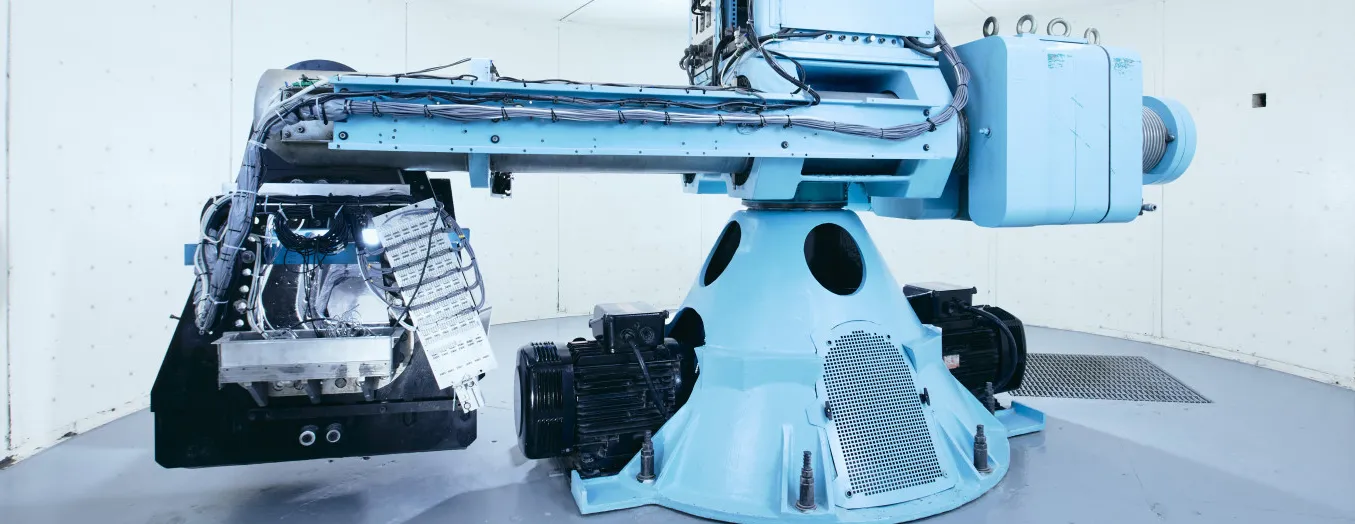
Research activities by applying centrifuge modeling techniques at Columbia University can be traced back to early 1930s when Philip B. Bucky, a professor of the School of Mines, proposed the centrifuge modeling concept, and published his works on the “Use of Models for the Study of Mining Problems” in 1931 and additional papers in 1934 and 1935.
Current research in the Concrete Materials Laboratory involves the characterization and development of advanced cement-based systems. Cement rheology and concrete processing are at the forefront of the research interests.
The Geotechnical Laboratory was established by Prof. Donald M. Burmister in 1933 as one of the first soil mechanics laboratories in the United States. It is now equipped with several unique apparatuses for advanced soil testing and research.
The Mindlin Laboratory was established to initiate research into the deterioration of suspension bridge main cable wires, work that has expanded into a major project on bridge cables and to a current focus of the Department on aging infrastructure in general. Today the Laboratory encompasses various projects related to deterioration of structural materials.
Experimental research in the Heffner Hydraulics Laboratory is investigating flow and transport in porous media systems from the nano-scale to the macro-scale.
The Carleton Laboratory library is located on the mezzanine level. It houses reference materials relevant to strength of materials testing as well as conference room infrastructure seating up to 10 people and A/V equipment available for use.
The Carleton Laboratory has a fully outfitted metalworking machine shop capable of machining parts, fittings, and testing enclosures in steel, non-ferrous metals, plexiglass, and wood. The Carleton Machine Shop’s machine shop is state of the art, either of the latest generation or recently rebuilt and modernized with digital readouts installed on core machine tools.
Housed on the mezzanine floor of the Carleton Laboratory, the SMaRT laboratory provides expertise and facilities for multidisciplinary research and education in advanced sensors, non-destructive evaluation devices, structural health monitoring, smart structures, robotics, and system control for civil infrastructure and military applications, with an emphasis on structural safety and system resilience against natural and man-made hazards.
The Carleton Laboratory maintains a medium-scale shake table facility to conduct experimentation in structural dynamics and particularly how to monitor and actively control structures subjected to earthquake ground motions or other force excitations.
Climate change, environmental deterioration, and materials and energy depletion have called much attention to the need for modernizing engineering practice and promoting sustainability in our infrastructure. SEML is a research facility aimed at characterizing the life cycle performance of novel and sustainable materials.